


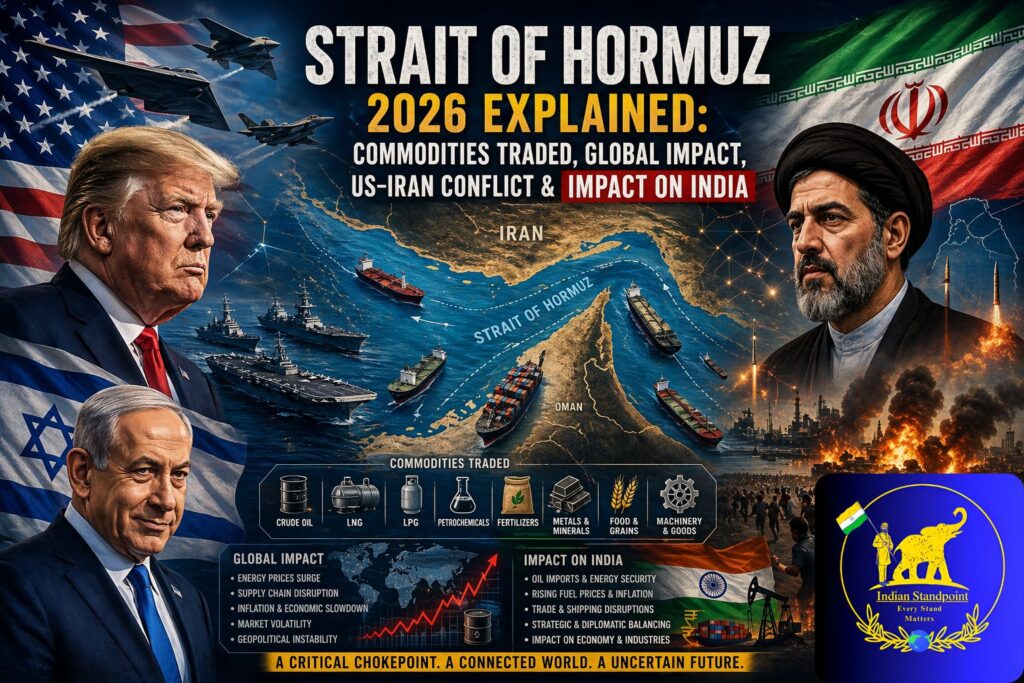
What is the Strait of Hormuz?
The Strait of Hormuz comes in news due to the recent US Iran conflict 2026. The Strait of Hormuz is a narrow maritime passage that connects the Persian Gulf with the Gulf of Oman, and further to the Arabian Sea. It lies between Iran to the north and Oman and the UAE to the south. The Strait is an important route for the transport of oil and natural gas from Gulf countries. Countries such as Saudi Arabia, Iraq, Kuwait, and Qatar use this route to export energy resources to global markets. According to the U.S. Energy Information Administration (EIA), about 20% of global petroleum liquids consumption passes through the Strait of Hormuz. In this article, the Indian Standpoint analysis provides clarity to the readers about the complete situation of Strait of Hormuz, US Iran war 2026 and its impact on India.

Brief History of Strait of Hormuz
Among scholars the word “Hormuz” is believed to have an origin in Persian language, possibly derived from “Hormoz” or “Ormuz” and it may be connected to the Ahura Mazda, the supreme deity of Zoroastrianism in the ancient Persian religion.
In the 16th Century, the Europeans, particularly Portuguese started the process of mapping and they documented this region including both island and the strait under the name Hormuz.
In present times, It is believed that the name of this strait is derived from the name of the Hormuz Island that is located near the coast of Iran. The name “Hormuz” of that island also comes from the historic Kingdom of Hormuz, in between the 13th and 17th Century which controlled regional trade routes between the Persian Gulf and the Indian Ocean.
Geography of the Strait of Hormuz
Strait – The strait is a geographical term used for the natural narrow water passage between two large water bodies and it is usually located between two land masses.
The Strait of Hormuz is located in the West Asia region and it connects the Persian Gulf to the Gulf of Oman that further connects with the Arabian Sea.
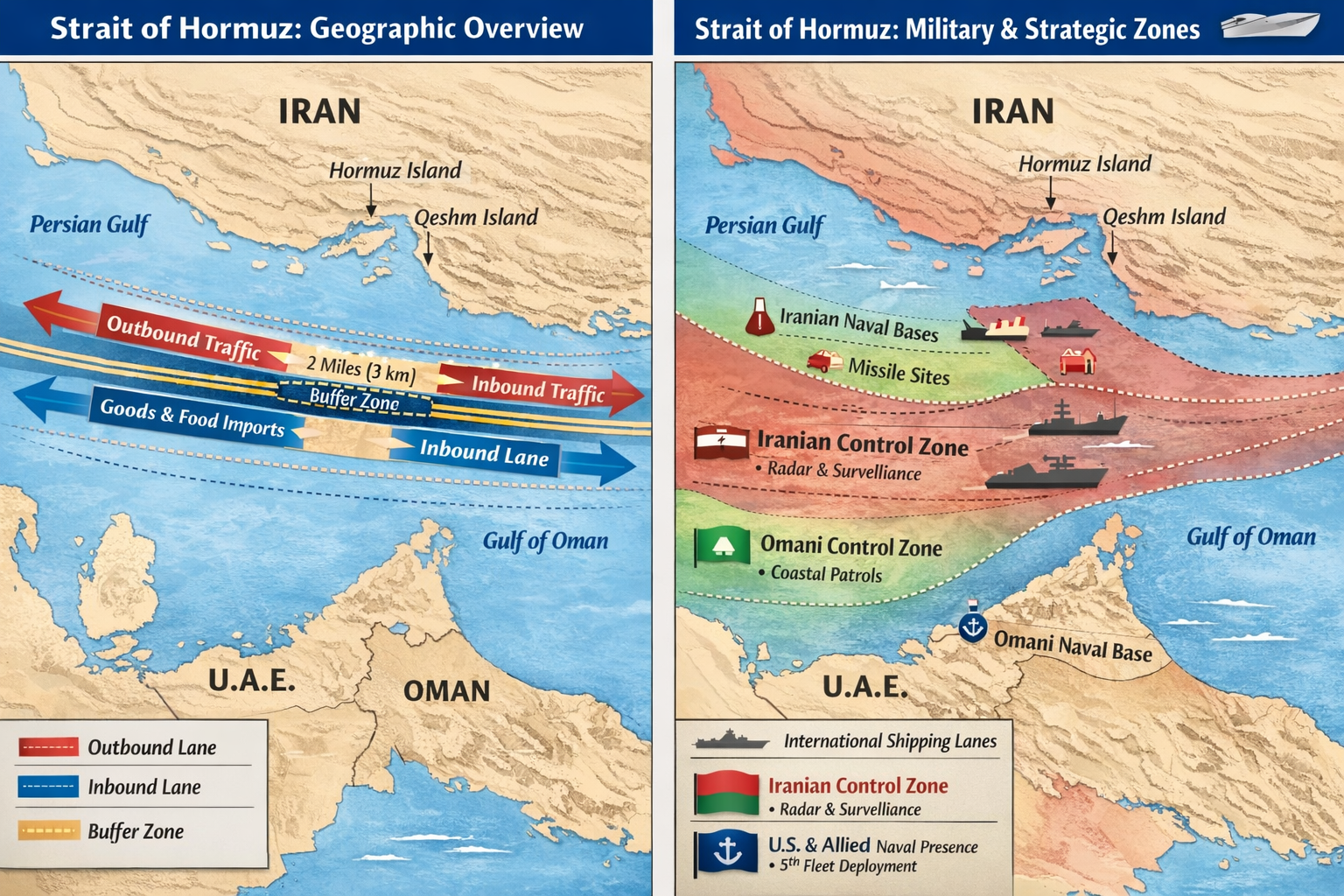
Geographically, the Strait of Hormuz is about 33 kilometers wide at its narrowest point. However, the designated shipping lanes are much narrower, with about 3 km width in each direction, separated by a buffer zone to manage traffic.
The northern coast along Iran is largely mountainous, formed by the Zagros Mountains, which extend along much of Iran’s southwestern region and reach toward the Strait. This terrain allows monitoring of maritime movement. The southern coast, along Oman and the UAE, has a more open landscape with ports and shipping infrastructure.
There are also several islands in and around the strait, some of which are under Iranian control. These islands are used for observation and administrative purposes.
The region experiences a hot desert climate (BWh under the Köppen classification), particularly along the coastal areas of Iran, Oman, and the United Arab Emirates, which are part of the broader Arabian Peninsula. This climate is characterised by high temperatures, low rainfall, and high humidity in coastal zones. Dust storms can sometimes affect visibility and navigation.
The Strait of Hormuz is a key maritime route due to its location and physical characteristics, and it plays a central role in the movement of energy supplies from the Gulf region.
Why is the Strait of Hormuz Important?

There are various aspects that depicts the importance of the Strait of Hormuz but in the conflict time of 2026 there are some specific reasons, that includes:
1. Major Oil Transit Route
A large share of the oil passes through this strait to the different nations of the globe. According to the U.S. Energy Information Administration (EIA), around 20% of global petroleum liquids consumption moves through this route. The exported oil from countries like Saudi Arabia, Iraq, Kuwait, and Qatar depends on the Strait of Hormuz.
2. Important Route of LNG Export
Apart from oil, the strait is also important for liquefied natural gas (LNG) transport. Qatar, one of the world’s largest LNG exporters, ships most of its gas through this route.
3. Connects the Key Water Bodies
The strait connects the Persian Gulf with the Gulf of Oman, allowing ships to move toward the Arabian Sea and beyond. This makes it an essential route for international maritime trade.
4. Limited Alternative Trade Route
There are few alternative sea routes for transporting oil from the Gulf region that make this Strait important for the oil exports.
5. Impact on Global Economy
The disruption in this strait can affect oil supply, which may lead to changes in global oil prices and impact the major economies in the world including India and China that depend on the natural gases and petroleum in this region.
6. Strategic and Military Importance
The strait lies between Iran and Oman, making it an important area for naval presence and monitoring of maritime movement. Several countries maintain a security presence to ensure safe passage of ships.
7. High Shipping Traffic
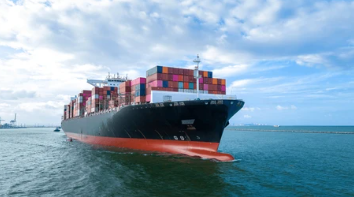
A large number of oil tankers and cargo ships pass through the strait daily, making it one of the busiest maritime routes in the region.
8. Energy Security for Importing Nations
Countries that depend on imported oil and gas closely monitor this route. Any disruption can affect energy supply chains and national energy planning of those particular nations.
9. Global Trade Connectivity
This strait also supports general cargo movement between Asia, Europe, and other regions, contributing to the important international trade flows.
10. Geopolitical Sensitivity
The location of this strait is often sensitive to the geopolitical developments in the region, especially involving countries in the Gulf region.
11. Presence of Military and Air Bases
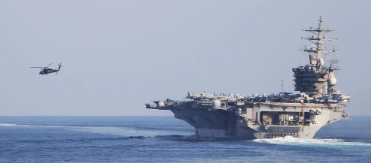
The region around the Strait of Hormuz hosts several military and air bases operated by countries such as the United States, United Kingdom, and regional powers like Iran and the United Arab Emirates. These bases are used for naval patrols, air surveillance, and securing maritime routes, reflecting the strategic importance of the area.
All the above mentioned points highlight some of the key importance of the Strait of Hormuz for the other nations of the world.
Has the Strait of Hormuz Ever Been Blocked in History?

In the contemporary political history of Strait of Hormuz has never been completely blocked but yes on some occasions this trade route was get interrupted due to several events, that includes:
1. Tanker War, 1984 to 1988
During the later phase of the Iran-Iraq War, both Iran and Iraq attacked oil tankers in the Persian Gulf.
- Over 400 ships were targeted.
- Shipping traffic continued but under risk and higher insurance costs.
2. U.S. Naval Intervention, 1987 to 1988
The United States launched Operation Earnest Will to escort oil tankers.
- This included the Operation Praying Mantis, a direct naval confrontation with Iran.
- The strait remained open despite military escalation.
3. Iran’s Closure Threats, 2011 to 2012
Amid rising sanctions, Iran stated it could close the strait.
- This followed U.S. and EU sanctions on Iran’s oil exports.
- No blockade was carried out, but global oil prices reacted to the threat.
4. Tanker Seizures and Attacks, 2019
In 2019, tensions increased with multiple incidents near the strait:
- Iran seized the British-flagged tanker Stena Impero.
- There were also attacks on commercial vessels near the Gulf of Oman.
- These events disrupted shipping confidence but did not stop traffic.
5. U.S. – Iran Escalation, 2020
The killing of Iranian General Qasem Soleimani by the United States leads to the rise of the tensions between both the nations.
- Iran again warned of possible action in the strait.
- Maritime movement continued without closure.
6. Ongoing Security Incidents, 2021 to 2023
There have been periodic reports of drone attacks, tanker seizures, and naval interceptions involving Iran, the United States, and allied forces.
- These incidents created temporary risks.
- The strait remained operational.
List of Commodities Traded through the Strait of Hormuz
| Commodity Category | Specific Commodities | Major Exporting Countries | Major Importing Countries | Strategic Notes |
| Crude Oil & Condensates | Crude oil, condensate | Saudi Arabia, Iraq, UAE, Kuwait, Iran | China, India, Japan, South Korea, EU | Accounts for approximately 20% of global oil consumption; critical to global energy security (Source: U.S. Energy Information Administration) |
| Liquefied Natural Gas (LNG) | LNG (methane gas) | Qatar (largest), UAE | China, India, Japan, South Korea | Estimated approx 20% of global LNG trade passes here; heavily Asia-bound |
| Liquefied Petroleum Gas (LPG) | Propane, butane | Qatar, Saudi Arabia, UAE | India, China, Southeast Asia | Essential for cooking fuel; high dependence in developing Asian economies |
| Refined Petroleum Products | Diesel, petrol, jet fuel, naphtha | Saudi Arabia, UAE, Kuwait | Asia, Africa | Price-sensitive; disruptions quickly affect global fuel markets |
| Petrochemicals | Ethylene, polyethylene, plastics | Saudi Arabia, Qatar, UAE | China, India, EU | Feedstock for manufacturing, textiles, packaging industries |
| Fertilizers and Inputs | Urea, Ammonia, Sulfur | Qatar, Saudi Arabia, Iran | India, Brazil, Africa | Direct impact on global agriculture and food production |
| Metals and Minerals | Aluminum, steel-related products | UAE, Bahrain, Qatar | EU, US, Asia | Energy-intensive exports tied to Gulf gas availability |
| Industrial Gases | Helium | Qatar (major global supplier) | US, EU, Asia | Critical for electronics, healthcare, and aerospace industries |
| Food and Agricultural Imports (Reverse Flow) | Wheat, rice, meat, dairy | India, US, EU, Australia | Gulf countries (Saudi Arabia, UAE, Qatar, Kuwait) | Gulf states import nearly 70 to 90% of food though this maritime routes |
| Machinery and Consumer Goods (Reverse Flow) | Electronics, vehicles, machinery | China, EU, Japan, South Korea | Gulf economies | Supports infrastructure, construction, and consumer markets |
Major Commodities Traded through the Strait of Hormuz and Key Insight of the trade data:
- As per the reports of visual capitalist, approximately 20% of global oil and 20% of LNG trade passes through the Strait of Hormuz.
- The reports of Visual Capitalist also estimated approx 90% of exports go to Asia.
- Trade is dominated by Gulf producers that export their products to the Asian consumers.
Trade Flow Structure
➤ Export Hub belongs to Energy Producers
- Persian Gulf states including Saudi Arabia, Iraq, UAE, Qatar, Iran and Kuwait.
➤ Import Hub that includes Energy Consumers
- Europe with 3.8% and the USA with 2.5% but Asia dominates, that includes:
- China with approx 37.7% consumer base.
- India with approx 14.7% of the consumer base.
- Japan with approx 10.9% consumer base.
- South Korea with approx 12% consumer base.
- Other Asian nations with approx 13.9% consumer base.
Key Strategic Observations
1. Energy Dominance
- Oil + LNG = core of Hormuz trade
- Any disruption in it can cause immediate global price shock.
2. Asia-Centric Dependency
- In the reports of Visual Capital, it is estimated that 90% flows go to Asia making it the most vulnerable region.
3. Industrial Supply Chain Linkages
- Fertilizers → agriculture
- Petrochemicals → plastics/textiles
- Helium → semiconductors
Meaning: Hormuz is not just an “oil chokepoint” but a multi-commodity global supply artery
4. Two-Way Trade System
- From Gulf : Energy, chemicals, metals
- To Gulf : Food, machinery, consumer goods
In summary we can say that the Strait of Hormuz functions as:
- A global energy highway,
- A fertiliser and industrial supply lifeline, and
- A food security corridor for Gulf nations.
The importance of the Strait of Hormuz is not just limited to oil trade routes only but it plays a crucial role in interconnected global supply chains, especially linking the Middle East with Asia’s industrial economies.
Alternatives of Strait of Hormuz?
The direct alternative maritime route of Strait of Hormuz is difficult to find for large-scale oil and gas transport from the Persian Gulf to the rest of the world. There are some options that people can adopt as an alternative route to the Strait of Hormuz. Some of the strategic options includes:
1. Saudi East – West Pipeline (Petroline)
Saudi Arabia operates the East – West Pipeline, which carries oil from its eastern fields to ports on the Red Sea.
- It allows exports without passing through the Strait of Hormuz.
- It is one of the largest existing alternatives, though still limited compared to total Gulf exports.
2. Abu Dhabi Crude Oil Pipeline
The UAE runs a pipeline from inland oil fields to Fujairah on the Gulf of Oman.
- Fujairah lies outside the Strait of Hormuz.
- This enables direct access to open sea routes.
3. Iraq – Turkey Pipeline
Iraq exports part of its oil via pipelines to Turkey, reaching the Mediterranean coast.
- This reduces dependence on Gulf shipping routes.
- Its usage depends on regional stability.
4. Red Sea – Suez Route
Oil transported to the Red Sea (via pipelines) can move through the Bab el-Mandeb and the Suez Canal toward Europe.
- This is an important alternative maritime pathway.
- However, it also involves another chokepoint.
5. Route Around the Cape of Good Hope
Ships can bypass Middle Eastern chokepoints by sailing around the Cape of Good Hope.
- This avoids both Hormuz and the Suez Canal.
- It significantly increases travel time and cost.
6. Ancient Land Trade Routes
The ancient silk route can be used for the goods moved through overland caravan routes linking the Gulf region with Iraq, Syria, and Turkey.
- These routes later became part of the Silk Road.
- They were used for trade in spices, textiles, and other goods.
7. International North – South Transport Corridor
The INSTC connects India, Iran, and Russia through a mix of sea, rail, and road routes.
- It provides an alternative for cargo movement.
- It is not designed for large-scale oil transport.
8. India – Middle East–Europe Economic Corridor

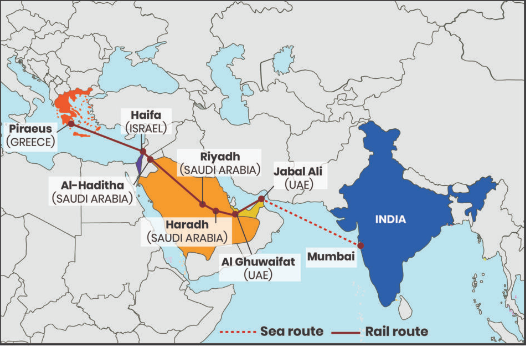
The proposed IMEC aims to connect India, the Gulf, and Europe through ports, railways, and infrastructure networks.
- It is a long-term project.
- It may reduce dependence on key maritime chokepoints.
9. Regional Rail and Road Networks
Some proposals involve transporting oil and goods across land within Saudi Arabia and the United Arab Emirates to ports on the Red Sea or Gulf of Oman.
- These routes are useful for limited cargo movement.
- They are not efficient for large-scale oil transport.
10. Strategic Storage and Diversification
Countries like India and China reduce dependence by maintaining strategic petroleum reserves and diversifying import sources.
These pipelines, longer sea routes, and land based trade corridors can play an important role as an alternative to the Strait of Hormuz only. These routes can play a role of alternative for limited time frames and for limited quantities of trade but all these options cannot play a complete role as an alternative of this strait.
Why is the USA targeting Iran?
The recent disruption of the Strait of Hormuz was started with the USA targeted attacks on Iran. There are various reasons of the USA’s targeting of Iran that includes:
- Concerns of Nuclear Program
The U.S. is trying to prevent Iran from developing nuclear weapons capability, especially after the weakening of the 2015 nuclear agreement. - Ballistic Missile Development
Iran’s growing missile range and technology are considered as a threat by the U.S. for its bases and allied countries in the region. - Regional Influence and Proxy Groups
Iran supports armed and political groups in countries like Iraq, Syria, and Lebanon, which challenges U.S. influence and interests in the region. - Control and Security of Energy Routes
The Strait of Hormuz is considered as the key global oil trade route. Any action by Iran can affect this passage and impact the supply of global energy. - Direct Military Confrontation
The recent strikes and counter-strikes between the U.S. and Iran have shifted tensions from indirect conflict to direct military engagement. - Long-standing Political Rivalry
Since the 1979 Iranian Revolution, both countries have had no formal diplomatic relations and remain strategic rivals. - U.S. Alliance Commitments
The U.S. supports regional allies like Israel and Gulf countries, and these allies considered Iran as a security threat to them. - Sanctions and Economic Pressure
The U.S. uses sanctions to limit Iran’s economy, oil exports, and military funding, leading to continuous confrontation between both the nations. - Military Presence and Base Security
The U.S. has military bases across the region of the Middle East. Iran’s actions and allied groups are seen as threats to these installations and personnel. - Maritime Security and Shipping Risks
The major incidents involving tanker seizures, drone attacks, and naval tensions increase the risk to international shipping in the region. - Ideological and Strategic Differences
The U.S. and Iran have fundamentally different political systems and foreign policy goals, which leads to mutual distrust among the nations. - Cyber and Intelligence Warfare
The U.S. and Iran have been involved in cyber operations and intelligence activities targeting each other’s infrastructure and systems. - The Epstein File
People on social media are posting that President Trump wants to shift the attention of the people of the USA and world from the recent most controversial and shocking revelation of images and videos from the Epstein FIle. These posts indicate that this conflict is used to hide the major issue related to this file.
The U.S. targeting of Iran is not only based on some personal rivalry between Iran and the USA but it is based on different aspects that includes geopolitical issues, military issues, internal politics and various ideological differences.
Timeline: U.S. – Iran Conflict EventsTill 2026
Historical Background
- 1953 – U.S. supports coup in Iran against Prime Minister Mohammad Mossadegh.
- 1979 – Iranian Revolution; start of hostility between U.S. and Iran.
- 1979 – 1981 – Iran Hostage Crisis.
Modern Escalation Phase
- 2015 – Nuclear deal named JCPOA was signed.
- 2018 – U.S. withdraws from JCPOA, reimposes sanctions.
Direct Confrontations
- 2020 – U.S. kills Iranian General Qasem Soleimani in Iraq
- 2020 – 2021 – Killing of Iranian nuclear scientist Mohsen Fakhrizadeh (widely attributed to Israel, supported by U.S. intelligence cooperation)
Pre – 2026 Build-Up
- 2025, June – 12-day conflict; U.S. strikes Iranian nuclear facilities
- Late 2025 – Jan 2026 – Protests and crackdown inside Iran; rising U.S. pressure
2026 War Phase
- Feb 28, 2026 – Start of Operation Epic Fury (U.S. – Israel strikes)
- Feb 28, 2026 – Killing of Supreme Leader Ali Khamenei
- March 2026 – Iran launches large-scale retaliation across the Middle East
- April 2026 – Active conflict continues; U.S.- Iran tensions remain high with ongoing strikes and rescue operations.
What are causes of Disruption in Strait of Hormuz in 2026?
In 2026, there are various reasons for these disruptions in the Strait of Hormuz region. A key additional factor is the role of Israel, which has contributed to escalation with Iran.
- U.S. – Iran Military Escalation
Direct confrontation between the United States and Iran has increased risks.
- Example: 2026 U.S. led strikes on Iranian targets followed by Iranian missile responses.
- Israel – Iran Shadow Conflict Turning Direct
The long-running covert conflict between Israel and Iran has intensified.
- Example: Assassination of nuclear scientist Mohsen Fakhrizadeh (2020, widely attributed to Israel).
- Example: Israeli strikes on Iranian-linked targets in Syria over the years.
- In 2026, this shadow conflict moved closer to direct confrontation, increasing regional instability.
3. Threats to Block the Strait – Iran has warned it could restrict the strait in response to pressure.
4. Tanker Seizures and Maritime Incidents – Shipping has been directly targeted.
5. Drone and Missile Attacks – Missile and drone use has increased risks to shipping.
6. Naval Build-up and Confrontations – Military presence raises chances of incidents.
7. Sanctions and Economic Pressure – Expected sanctions increase tensions and trigger responses.
8. Proxy Conflicts Involving Iran and Israel
Regional conflicts involving Iran-backed groups and Israeli responses add instability.
- Example: Ongoing tensions in Syria and Lebanon involving Israeli strikes on Iran-linked positions.
- Cyber and Navigation Disruptions
Electronic interference affects shipping safety.
- Example: GPS spoofing incidents reported in the Persian Gulf affecting vessels.
- Commercial and Insurance Impact
Shipping risk leads to economic disruption and rise in the prices of the insurance that impacts the overall pricing of the trade.
- High Traffic in a Narrow Passage
Geography increases vulnerability as the traffic in the region gets locked and gets narrow access to transport the goods to its destination.
The 2026 disruption in the Strait of Hormuz is not only limited to the U.S. – Iran conflict but it also includes the growing role of Israel – Iran confrontation, along with past patterns of tanker attacks, sanctions, and military escalation.
How Does The USA and Iran War Impact the World?
The 2026 conflict among the United States, Iran, and Israel is now impacting the whole world. Its impact is visible in energy markets, global trade, and international security. The common impacts of this conflict that world is suffering, includes:
1. Rise in Global Oil Prices
The conflict affects the flow of oil through the Strait of Hormuz, through which about 20% of global oil supply passes.
- Even the risk of disruption leads to price increases in global oil markets.
- Example: Similar spikes were seen during the Tanker War and the 2019 Gulf tensions.
2. Impact on Global Economy
Higher oil prices increase transportation and production costs worldwide.
- This leads to inflation, especially in energy-importing countries like India and China.
- Economic growth may slow due to rising costs.
3. Disruption of Global Trade
The Strait of Hormuz is a key shipping route.
- Any conflict or threat delays cargo movement.
- Shipping companies may reroute vessels, increasing time and cost.
4. Energy Security Concerns
Countries dependent on Gulf oil face supply risks.
- Governments may release oil from strategic reserves.
- Example: Similar actions were taken during past crises like the 1991 Gulf War.
5. Military Tensions and Global Security
The involvement of multiple countries increases the risk of wider conflict.
- Naval deployments by the U.S. in this region raise the chances of escalation.
- Regional instability may spread to nearby areas.
6. Impact on Shipping and Insurance
War-risk insurance premiums increase sharply.
- Example: During the 2019 tanker crisis, insurance costs for ships in the Gulf rose significantly.
- This increases the overall cost of global trade.
7. Supply Chain Disruptions
Industries dependent on fuel and raw materials face delays.
- Sectors like aviation, shipping, and manufacturing are directly affected.
8. Financial Market Volatility
Global stock markets react to uncertainty.
- Oil-importing countries often see market pressure.
- Energy companies may see short-term gains due to higher prices.
9. Humanitarian and Regional Impact
Conflict in the region can lead to displacement and civilian impact in affected areas.
- This may increase refugee flows and humanitarian challenges.
10. Shift in Global Alliances
Countries may adjust their foreign policies and alliances.
- Some may strengthen ties with the U.S., while others may move closer to Iran or neutral positions.
The 2026 conflict affects the world through energy supply, trade disruption, economic pressure, and security risks. The consequences of this conflict impacted on various aspects of the world and it has the potential to change the geopolitical equations in the region and the globe.
Impact of the USA and Iran War on India?
The 2026 conflict involving the United States, Iran, and Israel has made a significant impact on India on various grounds that includes economic, strategic, and social implications largely due to its dependence on the Gulf region and the Strait of Hormuz.
1. Energy Supply Disruption
India imports a large share of its crude oil and LPG through the Strait of Hormuz.
- Around 60% of crude oil imports and a majority of LPG supplies transit through this route.
- Disruptions in 2026 affected supply chains, leading to shortages and delays of both the commodities.
Case Reference:
- Reports of Indian LPG carriers being rerouted or delayed during the 2026 Gulf tensions that created the short term panic among the common citizens of India due to shortage of the LPS cylinders.
2. Rise in Oil Prices and Inflation
The conflict led to a sharp increase in global oil prices.
- Prices crossed $100 per barrel during peak tensions.
- This increased fuel costs, transportation expenses, and overall inflation in India.
Impact Areas:
- Petrol and diesel prices
- Food and logistics costs
- Government subsidy burden
3. Industrial and Economic Slowdown
Energy shortages and higher input costs affected industrial output.
- Sectors such as chemicals, fertilisers, and manufacturing faced disruptions.
- MSMEs were particularly impacted due to cost pressures.
Case Reference:
- Industrial clusters in Maharashtra reported significant financial losses due to rising fuel and raw material costs.
4. LPG and Gas Supply Crisis
India’s dependence on imported LPG made it vulnerable during the conflict.
- Supply disruptions created shortages in domestic and commercial sectors.
- Emergency measures were required to stabilize supply.
Case Reference:
- Delays in LPG shipments from Gulf suppliers during peak conflict periods.
5. Impact on Agriculture and Fertilizers
The Gulf region is a key supplier of fertilizers to India.
- Disruptions affected the availability of urea and phosphate.
- This created risks for agricultural productivity and food prices.
6. Supply Chain and Trade Disruptions
The Strait of Hormuz is a critical trade route.
- Shipping delays and rerouting increased logistics costs.
- Insurance premiums for vessels operating in the region rose significantly.
7. Currency and Financial Market Pressure
Higher import bills and global uncertainty affected India’s financial stability.
- The Indian Rupee faced depreciation pressure.
- Stock markets showed volatility due to global risk sentiment.
8. Impact on Indian Diaspora
India has a large workforce in Gulf countries.
- Conflict conditions created safety concerns and temporary return migration.
- Remittance flows faced uncertainty.
Case Reference:
- Evacuation and return of Indian workers and students during periods of heightened regional instability.
9. Strategic and Diplomatic Balancing
India had to maintain a balanced diplomatic approach between the entities involved in this conflict, that includes:
- United States (strategic partner)
- Iran (energy supplier)
- Israel (defense partner)
10. Sector-wise Domestic Impact
Multiple sectors within India experienced cost pressures:
- Aviation: Increase in fuel costs leading to higher ticket prices.
- Infrastructure: Rising project costs due to material and fuel inflation.
- Hospitality and services: Increased operational expenses.
In conclusion we can summarise, the 2026 Conflict of the US and Iran made these major impact on India, that includes:
- Energy Impact: Supply disruptions and rising fuel prices
- Economic Impact: Inflation, industrial slowdown, and increased import costs
- Strategic Impact: Diplomatic balancing and energy diversification
- Social Impact: Effects on households, agriculture, and diaspora
The dependency of India on the Gulf region for the petroleum and natural gas is one of the major reasons that this conflict impacts India and its people.
What can India do in the Strait of Hormuz Problem?
The Strait of Hormuz is not just a shipping route for India but it is a national vulnerability point. The diplomatic policies of India should be balanced and most importantly based on the interest of India and its people while maintaining the impression of major global power in the region. There are some suggestions from the Indian Standpoint for the India to take in its near future, that includes:
1. Quiet Energy Realignment, Not Public Diversification
India cannot “replace the Gulf” but that’s unrealistic. Instead, it is rebalancing at the margins.
- Increase spot purchases from Russia and the United States.
- Maintain baseline dependence on Gulf suppliers like Saudi Arabia and United Arab Emirates.
2. Maintain the Strategic Petroleum Reserves at Different Locations
India’s SPR is not designed for long wars—it is meant to buy time (2–3 weeks).
- Facilities at Visakhapatnam, Mangaluru, and Padur
- Used selectively to stabilize domestic prices and prevent panic
Key Insight:
SPR is a buffer, not a solution. It allows India to wait out short disruptions, not replace supply chains.
3. Naval Posture: Defensive, Not Interventionist
India will not militarize the Strait, but it will secure its shipping lanes.
- Indian Navy deployments in the Arabian Sea
- Escort operations for Indian-flagged vessels (similar to past Gulf missions)
Constraint:
India cannot challenge Iran or operate aggressively near the Strait without risking escalation.
Doctrine:
Presence without provocation
4. Diplomatic Balancing as a Strategic Tool
India’s biggest strength is that it talks to everyone involved in the conflict:
- United States (strategic partner)
- Iran (energy + geography)
- Israel (defense partner)
- Gulf monarchies (energy suppliers)
This is why, even during tensions, India explores reopening channels with Iran while maintaining U.S. alignment.
5. Chabahar: Strategic Insurance, Not an Alternative
The development of Chabahar Port is often overstated.
- It does not bypass the Strait of Hormuz for oil
- It provides strategic access to Afghanistan and Central Asia
6. Accepting the Structural Reality: No Full Alternative Exists
India understands a hard truth:
There is no scalable alternative to the Strait of Hormuz for energy imports.
Pipelines, corridors, and land routes:
- Cannot match tanker volume
- Are politically fragile
- Are economically expensive
7. Domestic Impact Management (Political Priority)
In a crisis, New Delhi’s first concern is not geopolitics but domestic stability.
- Control fuel price spikes (tax adjustments and subsidies)
- Ensure LPG availability (priority allocation of LPG)
- Prevent inflation spillover
The prices of fuel in India are a politically sensitive matter and not just an economic variable.
8. Long-Term Shift: Reduce Oil Intensity, Not Oil Dependence
India’s energy transition strategy is gradual:
- Expansion of solar and renewables
- Push for electric mobility
- Green hydrogen mission
Reality Check:
The use of oil will remain critical for decades but India should increase investment in research and developments to develop the alternatives of oil and reduce its oil dependency on imports.
Concluding Remark: Indian Standpoint on Strait of Hormuz
The Strait of Hormuz is an important trade route between the gulf nations and the world. The recent conflict among the USA, Iran and Israel significantly impacted this trade route that directly impacted the world economy and political relations. This disruption also raised some important questions about the alternative trade routes, alternative commodity options and most importantly the potential of the global leaders and the international organisations in the present world order.
The western neighbour of India, Pakistan is playing the role of mediator in this conflict and during the all party meeting on 25 March 2026, External Affairs Minister S. Jaishankar criticises this idea by saying “India is not a dalal nation”. We can conclude this remark as the actual stand of India in this USA, Iran and Israel conflict. This remark by EAM indicates that India is following the “doctrine of Strategic Autonomy” that stands on the thought of “No neutrality, no alignment”. The impact of this conflict on the trade routes of the Strait of Hormuz also affects India’s image as an emerging key power in the Indian Ocean region. India should remain vigilant regarding the Strait of Malacca, as reports mention that this region could be the next target of Trump’s policy. India should adopt a principled stance in favour of peace, while promoting the ancient philosophy of Vasudhaiva Kutumbakam, rather than limiting itself to neutrality, as principled stands matter in shaping its global role.
You can also check these links for the Detailed Analysis on Various Topics by Indian Standpoint
- US – Taliban Bagram Air Base Conflict 2025: Detailed Analysis by Indian Standpoint
- Air Defense Systems: Indian Standpoint’s Detailed Analysis
- Natural Disasters in Uttarakhand: An Indian Standpoint on Climate Change and Recommendations for a Safer Future
- Northwest Passage 2025: Trade, Absolute Geopolitics, and India’s Interest